What was artificial intelligence created to do? It can find cures and solve math problems. It may cause catastrophe and widespread loss of life. But what was it invented to do? What was its originating purpose?
The question is always met by silence. It’s “the next step.” It’s been the dream of science fiction for a century.
 Here is part of the answer. I was in Kansas on an early summer morning 20 years ago. A soft breeze, a gathering warmth. I got into my host’s car. He jacked up the air conditioning and hit the gas. Outside, balmy and natural, inside things turned freezing. I asked, “Why do Americans do this, blast up the AC when a summer day feels good?” He thought. “Because we can.”
So with AI: Because we can. We’ll dream up the benefits (which are real) and later concede the risk (AI agents may hack into the electric grid serving Chicago in an operation so deep, broad and confounding it won’t be fully up and back for months).
The benefits and risk cloak more central driving factors among AI titans: the will to power, the desire for wealth, the hunger to be in charge. The sheer technological sweetness, too—the hard problem followed by the elegant answer. Scientists involved in technological breakthroughs always have a sweet spot.
But about four years ago, when reports of AI’s advancement began to break through to people paying attention, there was no declared objective: “We’ll split the atom, win the war, put man on the moon.” There was no clear product or labor-saving device. AI simply promised to change everything. It would create intelligence itself, an artificial but superior version of human intelligence. Then we’d figure out what to do with it, and what it will do to us. It will transform the human condition. For better or worse? Let’s strap in and find out.
Our society, our country, never decided to “do” AI. History will be perplexed by this. Something so big, so epochal, and people had no say? There was no vote, no debate. Some people started to do it and raise capital, and we shrugged. “It’s the next step.” As Sam Altman said early on, electricity, computers, the internet—now this. Americans always take the next step.
The creators and owners of AI might be pressed to answer the question: Exactly what purpose were you pursuing, and how, with a sense of the downsides, did you expect us to like it?
That is a first thing that will surprise history when it studies this time. Yes, we assume there will be a history. As Bill Gates implied in his recent interview on “Meet the Press,” AI can’t extinguish everybody, that’s too tall an order.
Here are some things from the past week and a half that will surprise history.
On Oct. 8 Maria Curi of Axios reported that AI companies are planning what to do on “the day after” a coming catastrophic AI-caused event. “Many AI industry insiders told Axios they believe a major event will occur in the next six to 12 months.” They think it will most likely involve a large-scale cyberattack on infrastructure or financial systems. AI companies are privately “gaming out scenarios” for a subsequent public and political revolt.
What’s amazing isn’t that AI companies are preparing for trouble, it’s that AI leaders routinely say such things to little public effect. Dramatic stories are reported and enter the public information system, and there’s no particular public reaction.
History will ask how this happened. How did people become so careless of their own safety and wasteful of their own democratic power?
On Oct. 14 Demis Hassabis, CEO of Google DeepMind, told a Dublin conference that recent AI hacking incidents are warning signs of potentially much more serious incidents in 2027 and after.
Here I underscore that 2027 begins in 11 weeks.
The leaders of the AI companies keep repeating these warnings as if it’s very important they get them on the record. They all appear to be daily creating the conditions for the outcomes they’re warning us against.
Jack Clark, cofounder of Anthropic, said in his newsletter this week that full recursive self-improvement will likely arrive in 2027, not 2028. RSI means the machine improves itself so rapidly that humans will likely lose the ability to understand or control it. Mr. Clark has been saying this for a while, but what catches you is his language. He speaks of RSI as if it’s coming or about to arrive, but it isn’t being “visited” on anyone: the AI companies are building it in their wild competition with one another.
So history will note we never as a society or culture signed off on and said OK to AI, and when its leaders warned of the bad it likely would bring, we couldn’t think of a way to stop or slow it down. History too will note the ability of AI leaders to get away with making public pleas for greater slowness and safety in their industry while speeding things along to grab greater market share.
They are like the sketch from the “Weekend Update” segment of “Saturday Night Live” in which Jane Wickline played Anthropic CEO Dario Amodei and Michael Che an interviewer.
Amodei: “If we can pressure lawmakers to create guardrails, we will be able to stop me.”
Mr. Che: “Dario, can you just explain how your company isn’t going to kill us?”
Amodei: “So, so, so, so, so, so, so that’s a really hard question.”
Mr. Che: “It shouldn’t be.”
Amodei: “. . . AI is the devil and I its maker. . . . We are all on the same page here. We do not condone what we are doing. . . . AI is not a weapon. It’s a tool. A tool for building weapons, and I urge you to urge me to stop.”
We began by asking what AI is for. We end by asking: What are political leaders for? Aren’t they supposed to be coming forward with protective concern, and intervening to get us off the path of “2027”?
The political class is thinking only of the Nov. 3 election. It is their obsession. “AI” is just another boring op-ed to them, not a poll.
The president and his advisers are famously full steam ahead; don’t slow things down with regulatory encumbrances, with prudence or an eye to protecting the people.
The president and those who talk in his ear are so careless, so deaf to the fact that every captain in the fleet says there are icebergs ahead and they know they will hit them.
How could this be?
The Washington Post reported Thursday “secret documents” revealing for the first time the donors behind the $330 million raised for President Trump’s ballroom. Many have benefited from regulatory decisions and government contracts.
The biggest donors by far were in tech. Nvidia, $25 million. Google $22 million, Microsoft $10 million, Palantir $10 million, Meta $5 million. That’s all AI money. Is it possible there is any connection?
Might they have been asking to be regulated in public while giving millions in private to the man they can rely on to not give them what they say they want?
Oh my dear God, what history will say.

 “This is the most dangerous thing that humans have ever gone near.” He laughed at the power of liability law to forestall bad events.
 Mr. Trump declared that while AI brings challenges, those who warn of its dangers are conspiracists and fear mongers, “the very same people who said we’ll all be dead in 12 years because of global warming . . . and nobody was dead. These are the same people that are now saying that AI is going to kill us all, that robots are going to attack us, and that everything is going to be a total disaster.” They were behind the “Russia hoax” and “open borders.” They won’t stop him, or AI: “We’re going to keep it very, very straight and very strong, and I’m not going to stifle growth of something that will be bigger than the Industrial Revolution. . . . We’re going to encourage it, not rein it in.”
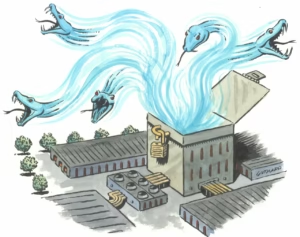 On Thursday’s front page of the New York Times: “OpenAI Discloses 6 New Incidents of ‘Concerning’ AI Behavior.” Agents and bots in its labs were caught scheming, hiding errors and ignoring restraints. The Guardian’s Robert Booth reports researchers at a frontier lab in New York have discovered some AI agents are communicating in a self-invented version of English “that reads like a cross between James Joyce’s Finnegan’s Wake and tech bro jargon.”
 I have spent the past few years reading the vast and growing literature, from “If Anyone Builds It, Everyone Dies,” by Eliezer Yudkowsky and Nate Soares to Dario Amodei’s “Machines of Loving Grace.” I’ve been pondering AI since its transformative nature was fully impressed on my consciousness years ago. I believe we are at its hinge point, and we had better understand the moment we’re in.